Friday, September 26, 2008

Nha Trang - Vietnam Part 2!

Hi everyone. So let's continue on our tour of Nha Trang Bay!

I took this shot from the upper level of the aquarium. The clowntrigger looks pretty cool!

Another shot from the upper level. I saw what appeared to be a school of fish in the enclosure to the right of the boat.

I walked down checked out the action. A school of giant batfish!

Another view of the aquarium as we were heading out.

While our crazy tour guide was babbling on, I decided to check out what was happening in the back of the boat.

The crew were preparing lunch.

There was a group of guys sitting on the floor splitting open sea urchins!

I didn't know you can eat these long spiny things!

Actually they were taking out the eggs, just like those expensive silly things at Japanese restaurants!

I've had fresh sea urchin eggs from freshly cracked open ones back in the Tonga days. The divers loved these and would bring on board huge specimens (short spined ones). We would scrape off the eggs from the inner sides of the urchin with boiled casava roots! My divers loved it but it was hard to swallow for me. Perhaps if I had some of that hot green stuff or soy sauce, it would have tasted better. But these bits of eggs from the long spined guys here would be made into "urchin egg congee"!

A basket of sea food for the stir fry!

Here is Anne and her brother Kye. Kye is the youngest of the siblings. Check out the shirt he is wearing, one of my old Bali ones that got too small for me.

Our next stop would be a reef area where a glass bottom boat was waiting for us. As we were closing in on the reef, I noticed a familiar structure on the water.

Wow, looks just like the floating platforms in Northern Bali! Remember those days when I used to walk on the small wooden walkways picking out aquacultures without trying not to fall in the water?

For sure any one of these floating platforms can easily be converted to an aquaculture station. The water conditions looked similar to Northern Bali too. But these floating platforms here were used to hold live fish and other seafood creatures!

So we anchored in a deep none reef area. While some of the tourists went swimming, we went on this glass bottom boat to check out the reefs! This wasn't part of the tour and it cost an extra $3 per person.

So here is what it looks like. The idea is great but someone needs to keep the viewing glass clean! It looked like a reef tank that wasn't cleaned in a week!

Some German friends were nice enough to take our group picture.

As we were heading out, this little "house boat" cruised by. Reminded me of my Tonga days. The local boats were similar to this design. I used to lay down on top of the house when I got sea sick!

We chugged along the shore and got into some shallow water. Unfortunately, I was very disappointed that this part of the reef was not good looking at all. I've been in this bay before and saw some really nice corals and reef structure but not in this spot. I couldn't really see under the glass bottom so I took some pictures from the side.

A huge patch of soft corals. These were growing literally within yards from the shore.

An acropora and some fungias.

Some porites, acroporas, and look to be echinoporas or turbinarias in the center.

You can see where the shore drops off in this picture.

Assorted soft corals.

As were heading back to our main boat, this guy came cruising along. For about a dollar, you can hop on this glass bottom boat instead!

Conclusion

Ok guys that is it for today. I have returned to Jakarta from coral hunting and have some exciting pictures to share after my "Vietnam Adventures" series.

Cheers,
Eddie

Nha Trang - Vietnam Part 1!

Hello everyone. Sorry for the delayed posting but I've been extremely busy preparing for another shipment. I'm posting from Sulawessi right now. Before moving on to my Vietnam Adventures, let's talk about what has been happening in this month of September here in Indonesia.

As some of you may know that the Muslim fasting month of Ramadhan is coming to a close. It will officially end on the 30th of September. Did you know that Indonesia is the biggest Muslim nation in the world? There are few Catholics, Protestants, and one island full of Hindus (Bali), but the majority are Muslims.

For many, this is really a hard time to survive and prove their faith. I say this as I see many Indonesian guys trying to cope with the fasting. Here is the typical day in the fasting period.

The day starts at 4 am. All over the country, there is a call for prayers on loudspeakers from the Mosques. It is really loud. It is a wake up call to start the day. Breakfast is served and coffee and smoking is consumed as much as possible. As soon as the sun rises, the fasting period starts for the day. When I say fasting, I mean no eating, drinking, smoking, cursing, making babies, getting mad at anyone, thinking bad stuff, etc.. you guys get my point? All this goes on until the sun sets around 6 pm! The only exception is for women. They are allowed to eat and drink during their menstrual cycle. Thank goodness, can you imagine your wife or girl during this particular period without food or drinks? I wouldn't want to be around them - probably get yelled at breathing their air!

The problem is for the guys, as I would say 99% of them all smoke. If you are a smoker or coffee drinker you know what I'm saying. This of course leads to more road rage and such.

After the fasting period ends, the biggest holiday of the year starts. It is called "Idul Fitri". Basically this would be equivalent to Christmas in the US. It is a four day holiday where over 2 million people travel to go back to their home villages to spend time with their families. People bring with them gifts, mostly clothes and such. The highways and waterways are all packed with travelers. This is especially a dangerous time for the people taking ferries to cross islands. The capacity is over extended and there is the danger of boats capsizing.

There is one interesting law that takes effect during this period. Before one week of the Idul Fitri, employers are required by law to give a bonus of one extra month's salary to the working force. There are even demonstrations for the government to crack down on companies that default on this occasion. The locals heavily rely on this extra bonus to make ends meet during this festive period.

Oh one more important thing that happened this month. I turned 40! Wow talk about being old. I don't look 40 but sure feel it! A fortune was told to me back a few years ago right before I took off to Tonga to start my ventures. I was told that I was going to loose money first, due to to my good nature in believing people. But after I turned 40, I would start making big money and be really successful. I was told that I was going to make a name for myself in my business and would have lots of enemies. This was told to me four years ago in Vietnam. Well I'm happy (or maybe not) to say that half of my fortune came true, as I went broke since that time. Believe it or not, only time will tell:)

We will talk more about the city of Nha Trang on a later post. But for now, let's move on to today's topic. After taking care of some business, we had one full day to enjoy this beautiful town on the southern coast of Vietnam.

We started the day around 7 am. Across the street from our hotel, there is this cafeteria style eating place.

A nice place to have noodle soup (pho) before venturing out for the day.

Of course, can't have breakfast without coffee. This mixture of very strong coffee and condensed milk is ready to be poured into a cup of ice. The caffeine and the sugar is enough to wake up a sleeping water buffalo!

For the day, we had bought a tour package that would take us around the Nha Trang bay and visit the islands. Way cool, since the package only cost $6-$10 per person (depends on where you buy the package). There were three of us, me and Anne and his brother Kye. At 8 am, a little van pulled up to our hotel to take us to the waiting boats at the marina. There were a bunch of tourists in the van already. We exchanged a few words and found out that they were from Holland and Germany. We got to the boat and it was crowded already. The tour guide surprisingly spoke good English and cracked dumb jokes from the start!

We started out to our first stop - an island that has an aquarium! As we were chugging along, we passed this tram that takes people from the mainland to this "Vinpearl" island. Someone had spent quite of bit of money to develop this deserted island to a paradise playground. From the brochure, it has a state of the art aquarium, all kinds of rides, animal shows, shopping mall, restaurants, and even a water park! The tram was built just for the park. There are ferries as well, but I guess the tram is more fun. You must have tickets to the island before you can ride the tram though. This Vinpearl island was not here two years ago when I visited this place. So I'm thinking it is fairly new and someone is banking on Nha Trang being a huge tourist trap. I will have to check it out the next time I'm in the area.

Check out these houses on this island. The houses are situated so that each one gets a good view of the bay:)

And here we come to our first stop - the aquarium island! Looks pretty cool, look like something from Disneyland!

We docked next to other boats that was there already. We had to "boat hop" to get to the shore!
Here is me and Anne, with our $.50 straw hats. Check out Anne's sunglasses, she thinks she is a movie star!
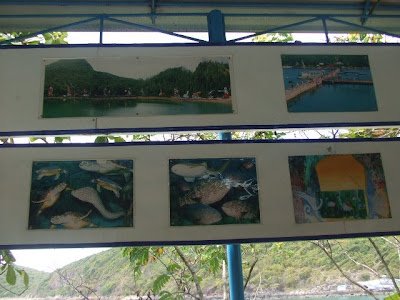
We walked up a trail and saw this sign. At least I know they have sea turtles here.

Here is the entrance to the aquarium. Pretty cool!

The trail lead us to this opening in the"mountain". I felt I was lining up for a ride at Disneyland!

The first thing I noticed upon entering the "mountain" was this tidepool.

At first glance, these looked like sarcophyton soft corals. But they are actually anemones!

We continued walking and saw this chart.

Nothing spectacular but for the average tourist, the colourful fish and background was enough.

A stonefish looking looking like a rock. I actually ate this fish at a Chinese seafood restaurant in Bali. Tastes lot better than it looks!

Some colourful tubeworms.

Some beautiful black ribbon eels. Did you know that these are juveniles? When they get old, they turn into the blue ribbon eel!

A huge grouper in the background. I think it weighs more than Anne!

A curious big boy with big bulging eye! All we need is a cleanershrimp in its mouth and the picture will be complete:)

So here is one of the turtles, a hawksbill. This must be the most common species of sea turtles there is. I see them everywhere where there are turtles.

This turtle I don't see too often. I think this is a ridley.

Here it is again, picture taken with a flash. This guys is actually yellow - kind of cute!

Big old tesselata moray eels!

Hey, kind of looks like the picture in the small sign as we were walking in!

A nurse looking shark.

We ended up downstairs looking into the tidepool. Well at least now you know how to say "coral reef fish, sea anemone, and coral" in Vietnamese now!

Some saddleback clownfish hosting in their anemone.

Here is a view of the island of anemones. All the anemones I saw on display were the ritteris - Heteractis magnificas.

Chicken fish, as we would say in Indonesia. This curious titan triggerfish kept following me around. Note the cleaner wrasse hanging close to him.

The reef was nothing spectacular or anything but it did represent a variety of fish from local waters.

I went up stairs again and zoomed in to take this picture of the "island of anemones".

Check out the monster anemone clinging to one of the pillars - must be 4 feet across!
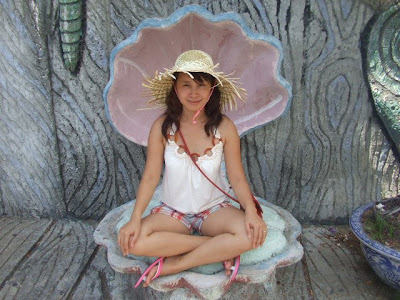
And finally, guess what I found in a clam shell? A beautiful young princess!!

Conclusion

OK guys, that is it for today. I will try to post part two of this series before heading back to Jakarta in a few days. Following the series, get ready for some very cool coral pictures from this trip!

Cheers,
Eddie

Thursday, September 18, 2008

Ecoreeffarms International - Aquaculture Database!

Hello everyone. Due to popular demand of my aquacultured corals, I have started a database. The following are pictures from my library and I will be updating as time goes. This is only a partial list, as there are many different species of sps available as aquaculture.

I will be adding this post to my "favorites" for reference. To my customers, please make sure to bookmark this page - Eddie.


Tuesday, September 16, 2008

Another great Shipment!

Hello everyone. Sorry for the late post but the internet has been horrible for the past week. Finally tonight, I can post pictures without hassles.

The following are some pictures from a recent shipment to the US. Keep in mind that not all of the corals pictured were exported. Along with these, the other corals from the previous posts were also sent out - enjoy!

This blastomussa wellsi rock actually has two different colonies. The damaged not so good looking one on the bottom and a killer "rainbow" one at the top. I eventually broke the rock in half and only exported the "cherry" piece.

Another nice blasto. This one is metallic red with a yellow trim - sweet!

A large very 'bubbly" yuma. The base color is actually reddish in color!

A cool looking fungia!

Very nice rose anemone. Among many things, anemones are one of my specialties!

Ok this is a very very rare metallic purple carpet anemone. The colors are little drab but should color up crazy under some good lights. This species is the one that might be a hybrid. It has the characteristics of a gigantea and a haddoni - only the third specimen I've seen since I've been here!

Gorgeous multicolor hellfire anemone. Although not reef safe, (because it eats fish readily), but is definitely a conversation piece.

A basket full of goodies! Trachy's, a red goniopora, a red zoo, and a couple of my rare acan - lobo corals!

Cynarina donuts anyone? Note the crazy lobophyllia on the left!

A shallow water lobo and a couple of deepwater guys. The deepwater ones develope this green rim that is just beautiful under halides.

A close up of the unidentified acan - lobo. These take some time to develop the bright green and orange. Under halides, it will look superb in one month. I have this piece quarantining under the 14k's right now.

A small colony of Acanthastrea lordhowensis! Just imagine how it will look under halides. This picture was taken with a flash at night.

Very nice oxypora chalice. These guys really need to be quarantined for days before doing any shipping. Usually the edges come in really damaged from the fishermen. Colors up very quickly under halides!

A basket of nice echinophyllias and oxypora chalices!

Guess what this coral is? Looks like a chalice or somesort, but a close up reveals that it is an Acanthastrea rotundoflora! One of the characteristics of this coral is its plating growth pattern, similar to an echinophyllia. This one already is developing a green rim. Normally, solid orange colored specimens always develope a green rim under artificial lighting. Definitely not a common coral!

Another beautiful blastomussa wellsi. This one sports a dark green center with red skirts. How rare? Only one piece out of hundreds has this morph. Sure there are the nice super green ones with the red skirts, but finding one with this shade of green is rare.

Three headed Acanthastrea maxima! The silver streaks can turn blue color under halides!

There is a reason why I travel all over to get the corals. My suppliers always has a wide variety for me to choose from. All of these look pretty good, but only a very few will qualify as "Eddies hand picks"!

So I made these zoos very popular. When I first got to the islands, nobody really wanted these, as the coverage was too little. Since then, everybody and their mother is looking for these. Truly unique and very rare!

Beautiful Acanthastrea echinata!

Another superb piece of Acan echinata. This color morph is the one known as "orange crush" in the US.

Gorgeous pink-purple centered , green rim Ricordia yuma!

A branch with three killer pieces of Ricordia red yuma!

Wow! This is one of the highlites from this batch of corals - a five headed metallic red Acanthastrea maxima! Placed next to a blasto, this coral looks identical to the casual eye.

Speaking of blastos, check out this beauty! Check out the size of the heads and the ultra color! This is one piece that I would consider an "ultra" blastomussa. Just amazing!

Just as amazing is this Ricordia blue yuma! It is super blue with orange tips everywhere! There were three crazy heads on this one rock. Unfortunately, only one survived the trip to Jakarta for export. Broke my heart when it arrived all slimy. I quickly chopped up the rock to save the one piece. Glad to say that the surviving piece made it to the US with no problems!

Here it is again, out of the water - check out the blue - crazy!

A couple of my rare finds. The one at the top is an Acanthastrea echinata (large heads). The one below is a true Indo Scolymia vitiensis. Strange thing is that this scoly has two heads on one rock!

Of course, always my favorite - the famous red yuma!

Just to give you an idea of what I'm faced when I visit my suppliers. From these batches, I pick out the best ones for my customers. Sometimes I find the rare red fungia!

Have a look at this little gorgeous lime green gigantea! What makes this specimen so special is not the bright purple verrucae, but the crazy blue base! Some lucky collector will end up with this prize!

A trio of my hand picked anemones. The rare purple one on the left and the green gigantea on the right will certainly brighten up any tank, although the red haddoni in the middle is nothing to be shamed of:)!

Another stunning carpet anemone! This one is a deep purple gigantea.

The purple long tentacle, Macrodactyla doreensis, is another favorite of mine!

Ok guys, don't let this picture fool you. These two red fungids (cycloseris) are extremely rare. My supplier knew I was coming and saved these two pieces for me. I hear somebody is selling frags of these in the US for big money. I wouldn't have the heart to break up such a stunning piece! One really cool thing is that this is the first time I've seen cycloseris of this type in the metallic red morph. Usually the red fungias (cycloseris) is the flat ones typically looking like a fungia.

But unfortunately, one of them came in damaged during shipping from the islands. But I'm happy to say that it is healing up nicely. When fully opened under our 14k halides, you can't see the skeleton!

Conclusion,

Ok guys, that is it for today. For our next topic, we will go back to my "Vietnam Adventures".

Cheers,
Eddie

Tuesday, September 9, 2008

Corals under Halides!

Hello everyone. So I've been busy preparing for an order to the US. Below are some pictures of corals that I've been holding in our system. We have a single 150 watt 14k double ended metal halide pendant over one of our tanks. The new video of the corals cannot be uploaded as the internet has been too slow. We will keep trying. In a few hours, we are packing for the US. I will do write ups on the corals after packing. But meanwhile, enjoy the pictures - Eddie.

A beautiful array of cynarnina donuts and trachyphyllias! These are new corals that I just acquired from the islands.

Remember the montis from a few posts ago? I brought a few pieces back to our quarantine facility after they turned kind of brown at our export facility. But behold, you can still see the orange polyps mixed in with the green polyps under the 14k. With the base color of purple, you definitely can say that this one is a "rainbow monti"!

Even though it had turned quite bit of brown, under halides you can still see the orange polyps with the underlying purple base - can you say "Clark, or better yet superman"!

Beautiful two toned oxypora chalice anyone?

Same coral, different pattern. Note the pinkish - purplish centers around the eyes - way cool!

I call this the Makassar red zoanthid. If you look carefully, you can see the very rare speckled zoos that are mixed in.

Another Makassar specialty, though not too common. Pretty sky blue with bright orange skirts!

Metallic green and red blastomussa!

Ok so this is one of my personal collection pieces. Looks like a crazy lobophyllia with acan colors. Still haven't positively id it yet. There are group of these lobo looking guys that are very similar to acanthastreas.

Another gem from my collection - the rare Acanthastrea bowerbanki!

So this little guy is also one of my personal pieces. Looks like a cyphastrea to me!

A purple Acanthastrea maxima to sooth you purple fans!

Another group of cool little cherries from my collection. Acan or lobo, you decide!

Check out the "sweetie" on the right upper corner. That piece is a pink centered Acan bowerbanki. It developed the colors under the halide in a matter of months.

Another piece from my collection - a three headed mini lobo acan!

So I've had this fungia for a long time. I got it in with a slight hint of red, 99% brown. But it is developing nicely under the halide. It will need to be more colored up before I can export it.

This is a very rare multi headed Acan max colony. It looks like a lordhowensis but a close up view when the tissue is drawn tells otherwise. I have had this piece for about 6 months now. One of my favorites in my collection!

This echinophyllia chalice is new. I used the flash but you can still make out the green base with pink eyes - very cool!

Check out these "cherries"! The blue blasto is on its way to the US as we speak!

There seems to be two morphs of my "speckled zoo". This is the one with less speckles, and always found on big rock with few heads. My guess is that this zoanthid grows very slowly.

Nice looking trachyphyllia. Note the red centered zoo partially covering the open brain.

Metallic pink goniopora with purple centers - sweet!

Ok so this special zoanthid is the second one that I've exported. I had two pieces but one melted during shipping from the islands. It doesn't look much under regular lighting, but under halides, very nice! This color morph is even more rare than the red speckled ones. I called this the marbled zoo!

Conslusion

Ok guys, that is it for today. My next post will be on some of the highlites from a shipment that just left for the US.

Cheers,
Eddie

Thursday, September 4, 2008

Tragedy in Tonga!

Hello everyone. For today, I would like to talk about a tragic event that occurred last Friday in the Kingdom of Tonga. I have been corresponding with my old coral diver that still works with my former company. Two boats and two boatman are missing. One of the guys that is missing used to be one of my guys. His name is Tony and he is from Vanuatu. He lives in Tonga and is married to a local and has children. My heart sank as I heard the news. You see Tony and I spent a lot of time together on the boats acting as boatman. He and I would talk about many things while waiting for the coral or the fish guys to come back up. I even caught him sneaking out with our boat at night to do night fishing. I used to fill the fuel tanks at night for the boats, and by morning some of it had been used. Cleverly disguised but I knew there were some missing. So one night me and my lead coral diver stayed up late and drove by our boat. It was missing! Of course I had to scold him and told him that if he wants to go night fishing, then let me know. If the guys did a good job on collecting corals let's say, I would let them use the boat.

Evidently last Friday, two boats went out on the east side of the main island to catch fish. The east side is a nasty place to be, with heavy currents and huge surges. This is where the famous blowholes of Tonga are. Huge waves smashes into the coast line and water travels into channels in the ground. Once it can't go anywhere, it pushes upward through an opening. The water shoots up way into the sky, thus "blowhole".

Each of the boats has Filipino fish divers and a local boatman that operates the boat and helps with changing scuba tanks. It is common for our guys to go out with guys from another company. The Filipinos are all friends and sometimes work together to catch fish. The fish are shared between the two companies afterwards.

After the Filipino divers surfaced to change their oxygen tanks, the boats were gone. Both boats and boatmen had vanished. The divers swam to shore and soon the search was on.

This is the theory. This area is known for huge underground caves. During low tide, water surges in with great force. Somehow the boats may have capsized and with the guys, got sucked into the caves. These are small boats and if there is a sudden big wave, it can flip over. What ever happened, it happened very fast, as these guys are excellent boat handlers. Also being excellent swimmers, (at least Tony) they should have been able to swim to shore. Diving for fish and corals is a dangerous job. Once in a while these tragic accidents do happen. Below are two of my personal experiences that really put a scare in me about what we do.

Once I was watching our boat waiting for my coral divers to come up. I was anchored in about 10 feet of water on a reef. It was about 10 minutes into the waiting game and I started feeling not so good in my stomach. The waves had picked up and I was turning blue. So I laid down on the bow and closed my eyes. I must have dozed off for few minutes. I woke up to see one of my divers yelling and holding up the anchor! Holy crap, the rope had come loose and I was drifting. In the few minutes that I dozed off, I drifted about 100 yards! So you can see how lucky I was that my guy surfaced when he did. My guys could have swam to a nearby island no problem, but for me, I would have been lost. The currents are so quick that if I had dozed off for an hour, I could be in the middle of the ocean and wouldn't know which way to go! After that incident, I made sure for the safety of my guys and me, that I would keep alert at all times - even if I have to puke!

The second incident is 100 times more frightening. We were on a large marlin boat (we were borrowing it from the queen) in the open ocean. We were in search of blue tangs. Me and Robert (owner of Aquatic Specialties and Pets) were with our three Filipino and two Tongan divers. The Tonga guys were training to catch fish with the Filipinos. They had "graduated" from coral collecting. Our captain was very experienced and we had one first mate. We were very far out from the mainland, couldn't see any islands at all. The divers went down to the reef below and our captain started to follow the bubbles of the divers. About 10 minutes later, our captain lost the bubbles! We circled the area and waited for the guys to surface. Another 20 minutes later, there were no signs of the guys. Another 10 minutes in and they should have all ran out of oxygen and be up but no sign of them. Holy crap! We started to panic and our captain just started to go in all directions looking for the guys. I felt this cold chill up my spine and truly realized the scope of our situation. There was a good chance that we would never see my divers again! Me and Robert said nothing trying to stay calm and focused in the horizon for any signs.

What felt like eternity, after another 30 minutes later of going in all directions, we heard the faint cries. We had a GPS, but didn't matter, as the current could have taken the guys anywhere. Way in the distance, I saw the water splashing. The guys were huddled together and used their fins to splash water into the air. You cannot begin to imagine how relieved Robert and I were. The divers were pretty pissed as you can imagine. They had been watching us and yelling but we couldn't hear or see them. I can imagine how they felt as they saw us go in circles trying to find them. Their whole life depended on which direction we would go. They would loose hope as they saw us go off away from them. Then only to have hope as we turned around. But remember we were just going every different direction panicking. I felt extremely lucky that we didn't loose our guys.

Some of the divers had dropped their equipment, but our head Tongan guy came onto the boat clutching the bucket of blue tangs! I was thinking "what the hell?" It was the funniest thing! I couldn't help laugh and the guys all laughed with me. Everyone was just glad to be back on the boat. I wanted to call it a day but the divers wanted to catch fish. So we headed back to the harbor area and anchored in a lagoon next to one of the islands. Here we spent the day catching common bread and butter fish.

After the incident, I told our guys "no more open water diving", ever! Way too dangerous. Our captain also resigned after the incident.

Conclusion

After my personal experiences, I developed much more respect for the divers. After the incident, it wasn't the same for me when I go out with the guys on the boat. I became lot more cautious and developed a whole lot of respect for mother nature.

As for the poor guys in Tonga, my heart goes out to the families. I just hope the owners of the companies take responsibility and take care of the families of the lost ones.

Just so you know, last year, two Filipino divers never surfaced after going down in Tonga. That company is no longer in business. Filipino divers in Vanuatu and also in the Red Sea have died. These are just a few incidents that I know of. Just what is the price to pay for having pretty little fish in our aquariums?

Since the incident, both companies have stopped all operations. I personally feel that the whole aquarium fish/coral trade in Tonga is in jeopardy, especially in light of the liverock closure and a reduction in hard corals. Add to this, the deaths of locals will definitely have a huge impact.

I see the similarities in the aquarium fish trade with the sea cucumber trade years ago. Years ago, there was a thriving business in sea cucumbers in Tonga. These things are everywhere and easy to collect. They are gutted and cooked and dried for export. Markets in Hong Kong, Taiwan, Korea, etc. can't get enough of this stuff. Some of the best species can go for $40 a kilo! As the long slimy guys started to disappear in the shallow water, locals started using hooka rigs (compressor) to go down to deeper water to collect the cucumbers. Of course the locals were never trained on decompression and such dangers of diving. People started to die from decompression sickness, or would stay down too long. In the end, the King stepped in and put a moratorium on the sea cucumber trade. Not just that, he outlawed the use of compressors. That is why all the divers use scuba. I have heard that the compressors are actually safer than scuba. One obvious reason is that you can't get lost as you are tied to the long hose that provides the oxygen from the boat.

Are you getting my point? Now do you see why I think the whole aquarium fish/coral trade is in danger?

The next time you look at your aquarium, please give a moment of silence and think about the poor guys that have lost their lives so we can have pretty fish in our aquariums.

Thank you,
Eddie

Aquaculture Northern Bali

November Corals Collection Part. 1

November Corals Collection Part. 2

Aquaculture - November Shipment

Coral Showcase - September 2008 Inventory

Holding Facility's Corals Collection Showcase 2007