Friday, October 8, 2010

Tonga - Day 11!

Hi everyone. So let's continue on to day 11 of my "Tonga adventures".

Computer work and such kept me in the "office" for most of the day. I got to the fisheries facility a little later in the afternoon. These two cool dudes are from AusAid, an Australian government agency that helps developing countries worldwide. In Tonga, AusAid provides funding and consultation to the Fisheries department as an ongoing support to help with various projects. Right before I left, these guys were gearing up to make a "road trip" to Ha'apai to collect clam broodstock. Man, I wish I could have stayed longer, would have loved to tag along and share the adventures with you. Anyways, I got to the facility and these two down under dudes (duds), had just come back from harvesting sea weed for their study subjects, the sea urchins. The guys were studying growth rates of the echinoderms.

Here is one urchin and in the Japanese sushi world, this guy would be worth a lot of money. The eggs inside is a delicacy. I have eaten the eggs before and it taste like dirt! I guess it is an acquired taste and I am not fined tuned enough for it - where is the can of mackerl!

The hungry urchins were devouring the sea weed!

A custom made enclosure just for the round spiky guys. The water entering the tank is natural sea water being pumped in from at least a hundred yards out.

Here is the water being drained into the raceway gutters.

I followed the raceway to this point, then it disappeared under the street.

Three very happy rose anemones minding their own business in the raceway! Everyone in the raceway is happy. Corals stop dying, even recover once put into the fast current. This reinforces how important it is to have the good flow in our reef aquariums. I am going to monitor these three roses every time I go back to Tonga!

The raceway drain runs under the street and runs along the pump house. That big reservoir at the top of the building is where the water is being pumped into. From there, it gravity feeds down into the tanks at the facility. The water to the tanks are controlled by numerous valves. To the right of the building are sand filters, but not being used. I guess it is better without these filters in this situation. It allows lots of plankton to enter the clam and coral tanks.

This multi million dollar facility was set up by the Japanese a long time ago. They set it up and trained the locals on clam farming and left. It was a gift, kind of like what the AusAid is doing now.

This thing looked like a back up generator, fairly new too!

These pumps and valves looked liked it was for the sand filter system. The motors were not running.

A big crate. Most likely some new equipment had arrived from Japan recently.

At current, two giant pumps were being used to pump water from the ocean to the reservoir up on the roof. The middle pump looked like it was being serviced.

These monster Toshiba pumps looked to be pretty new.

Good to see that things were being monitored!

This is the back of the pump house. Note the three pipes for the three pumps.

I went outside again and followed the raceway.

And it emptied into this settling area. I'm sure all kinds of cool things were living in here!

There were halimeda, the calcalreous algae growing at the bottom of the pond.

Also growing along with the halimeda, was a dense layer of Caulerpa racemosa. This "grape" algae is a local favorite food item, so I wouldn't be surprised if these were harvested regularly.


The water eventually drained on the other side of the pond into this corner.


The drain pipe disappeared into the rocks.

And reappeared on the other side!

Here is a close up of the drain. I could see little crabs and all kinds of stuff running around at the bottom of this "waterfall". I guess it is a good place to hang out to catch or look for food.

The water eventually disappeared into the mangroves and back out to the sea.

I walked around a bit and later found these local kids (the big guy is also a kid), playing in the settling pond!

Conclusion

Ok boys and girls, that is it for today. Uncle Eddie will tell you all about what he did the next day very soon:). All I can say is that the tide was out and I was having fun playing with sea shore animals!

Cheers,
Eddie


Sunday, September 26, 2010

Tonga - Day 10!

Hello everyone. The shipment went off without problems (weather and plane mechanical problems are common in this business). It was time to clean up and prepare for the next shipment. But first, I had to get some breakfast!

I stopped by Friend's cafe and had this great breakfast. Three egg omelette, toast, and bacon with "flat white" coffee. Most of dairy products come from New Zealand, so you can imagine how good it tastes! Back five years ago I ate at this same cafe and ordered the same breakfast. The only exception was that they didn't give any jelly for the toast. I asked the people for some jelly, and soon enough they brought me this brown stuff in a little tiny cup. I put it on my toast and wow! It was the nastiest thing ever. "What is this stuff?" It turned out to be a product called "vegemite". "Called what?" "What's it made from, cow poop?", I asked. Everyone laughed and explained that it is a popular product in Australia, used as a spread on toast and other things. "Crazy Aussies eating crazy things", I thought to myself. But heck, I guess it is an acquired taste, just like durian - the stinky fruit. This fruit is very popular in Southeast Asia and has a terrible smell, like my poop! But people love it and I can't even stand the smell!

Some entertainment from local old timers. Nice island music!

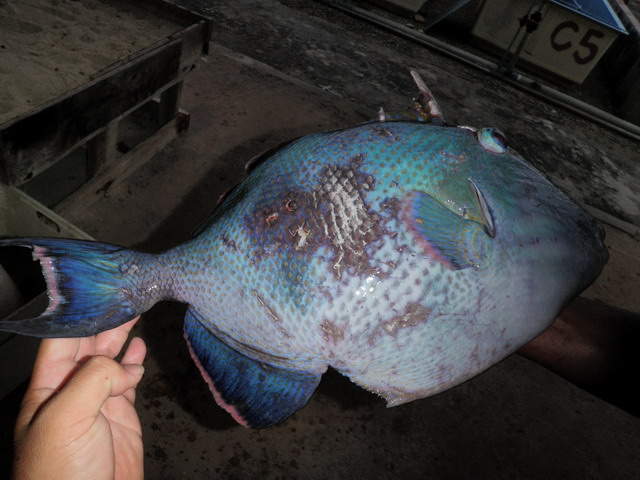
So after the hearty breakfast, I headed to the Fisheries facility to clean up the tanks and organize for the next shipment. I stayed there the whole day and waited for my guys to come back from collecting. "Eddie, check out this fish I caught, what is it?". What the heck! "Dude, you shot a blue lined trigger!" And it was a huge full grown specimen with spectacular colors. Teau also shot himself an octopus too.

Even after being dead for hours, you can still make out the beautiful colors. Check out the pink rim around its fins!

Big nasty teeth can probably take a finger off!

My heart sank as I looked at this dead gorgeous fish. The triggers are known as "chicken fish" in Indonesia because their meat does taste like chicken. It flakes off in chunks like canned albacore. "You are a savage dude, why you shoot this beautiful fish?!" "Hey man, it's food". " Ok man, you stay away from me, you might shoot me and eat me too!" We all laughed. But seriously this was a stunning fish and I wish I could've seen it alive. What many us hobbyists don't realize is that many of the fish available to us in the trade are actually juveniles. Full grown show sized tangs, triggers, angels, and other fish display the true colors of the species that we do not get to see. Big fish like this, needs to be left alone in the wild. First, big show fish like this are breeders, no need to explain how important it is to preserve the big ones that make the small ones. Second, it is too big to ship anyway and probably will die during transit.

The local name of this purple and green anemone is called "malu" anemone. But upon close inspection, it appears to be a Heteractis crispa - a sebae anemone!

So this ugly creature from the deep has been the hype for the past months. It is a sea cucumber and license to harvest these guys was released earlier this year. About ten years ago, a moratorium was set in place by the King, after the locals not trained properly on deep diving, used compressors to go collect these highly prized sea foods. Both collection and compressors were banned in Tonga waters. This is one reason why everyone uses scuba instead of the more safer and less expensive compressors. Talk of releasing licenses to harvest sea cucumbers were buzzing around even five years back when I first started my venture. Finally this year, a set of licenses were released, prompting a mass total destruction of these bottom creatures. Big greedy Asian companies from Korea, Japan, Taiwan, Hong Kong, using multiple licenses came in and hauled off tons of these helpless "turds". I hear the next time sea cucumbers can be harvested is in ten years.

As I have said before, wild xenias are extremely hard to ship. Still customers want to try, so I do the best I can to get these sensitive corals to them. Small specimens like this ship better than larger colonies. While I was holding to take the picture, a xenia crab came crawling out!

Here is a closer picture of the crab and xenia. Note the colors are identical to each other. Even the darker stripes on the crab matches the darker stems of the xenia - wow!

Underside reveals that it is a female full of eggs. Unfortunately these crabs eat the xenia that it is living on. I suspect that the actual damage is very little though. The crab probably eats some and the xenia simply heals back. I have seen many xenias before and never had one looked damaged because of a crab.

It was dark and I couldn't see much. I decided to take a few photos and "get out of dodge", as the mosquitoes were starting to swarm! Nice red lobo with a white rim.

Another red lobo but with green edges!

Cute little chalice with bright green eyes!

Marbled two headed Scolymia vitiensis.

So this is one of the corals that Tonga is famous for, the Acanthastrea subechinata. This particular specimen is totally unreal. The colors are actually sky blue and purple! Wow!!! Like good old MC Hammer used to say "can't touch this"!

Orange green montipora with red/pink polyps are super nice!

Red marbled favia is uncommon even in Tonga!

So take a look at this beauty! Can you guess what it is? At first glance it looks like a Cynarina lacrymalis. But the tissue is not translucent and the skeletal teeth are too small to be a Cynarina. So it can only be its cousin, the donut coral (Acanthophyllia desheysiana). The only problem is that it does not look like the Indo or Australian donut coral. Even the skeletal teeth that protrudes upwards does not look like those of an Acanthophyllia. Perhaps a new Acanthophyllia species? I have only seen one specimen so far, and this is it. I hope to find a red one someday!

Conclusion

Ok guys that is it for today. Tomorrow I will be heading to Jakarta. Just a few more posts and we will be done with Tonga.

Cheers,
Eddie

Thursday, September 23, 2010

Tonga - Day 9!

Hello everyone. Today is day nine, and we are packing!

After running around town doing errands, like getting money and paying cargo, I stopped at this cafe to get something to eat.

Pretty nice inside. Back five years ago me and my business partner used to have a breakfast meeting here every morning.

I ordered this pasta with clams and garlic bread. Simple egg breakfast was not going to keep me going all day at packing. So I filled up with lots of carbs!

I got a water to go. You probably recognize this brand from Starbucks and other high end cafes and grocery stores. It is bottled in Fiji and readily available in Tonga. The story goes that once Tom Cruise was seen on TV drinking this water. Afterwards, the demand for this water sky rocketed. Coca-cola soon bought out the Fiji company.

I got to the Fisheries facility and my guys were preparing for the pack. Here natural seawater is being filtered through a micron bag for packing water.

Packing water being oxygenated.

Bags of ice to cool down the packing water. No luxuries as chillers here!

Normally we keep this tank empty, and use just for packing.

The night before, selected corals are floated. Leather corals, acros, and euphyllias are the ones that does best floated.

Assorted soft corals ready to be bagged. We like to collect these early in the week. Tongan softies are very sensitive when it comes to packing, so they must be well quarantined.

Out of 100 softies, only half may be good enough to send. Others will have slight damage or have melted. We like to put the damaged ones in the raceway gutters where there is fast flow from all the overflows from the tanks. Most recover in a week and good to go. Overall, the trick to get these sensitive softies to arrive alive is to quarantine them for a good period of time. The softy pictured is the famous Tongan yellow leather.

This Sinularia sp, locally called spaghetti leather, is the most sensitive among the leather family in Tonga (exception is the xenia). But if it arrives in good condition overseas, they do great in aquariums. Indo softies for the most part are very easy to ship compared to Tongan ones. For those of you that don't know, xenias are really hard to ship. Reefers sometimes refers to them as "weeds" because they grow so fast. But what they don't know is that wild xenias require huge amounts of water and oxygen to be shipped, even then the survival rate is very low. But once again, if they arrive in good condition, they are bulletproof!

The finger leather, this lobophyton is becoming very popular from Tonga. These come in yellow and green with green polyps. Sometimes a total brown with super metallic green polyps will be found. These are insane looking!

I ordered from locals some inverts. I asked for small turbo snails and these Tongan sized ones were brought to me. Too big for aquarium use and my divers ended up taking them home for dinner.

A makeshift packing station.

Plastic bags for packing. The big problem about Tonga is that everything has to be brought in from overseas. Everything from rubber bands to boxes, the costs are high. Not like here in Indo, where everything is readily available.

Corals to be shipped are placed into the packing tank. Here they sit while the water cools down. Good to have the corals get acclimated to the cooler water before packing.

Carbon is used to keep toxins at bay. Soft corals especially will benefit from the carbon. A little spoon full is used on the softs, while half the amount is used on hard corals.

After the coral is packed, it is placed in another bigger bag before being placed in the box. During flight the bag will expand and then deflate when the plane descends. It is at this point that the bags can collapse and end up laying on its side (or even burst), spilling the water out. So the extra outer bag helps to keep the water from spilling all over. Note the floating carbon pieces!

Ice packs are used to keep the corals cool during transit.

A scale to weigh the boxes. Our boxes weigh around 27-30 kilos each. In Indonesia, normal weight is 22-23 kilos, but again we use bigger boxes from Tonga.

After a hard day of packing it was time to get some grub. We hit a local fast food place and my guy ordered this barbecue combo - chicken and hot dog with coleslaw and rice.

My other guy got tapioca root with curry chicken. Curry and barbecue are most popular in Tonga.

And for me, "Kentucky" as it is called. As you probably already guessed, fried chicken!

Conclusion

Ok guys that is it for today. I am posting this from Bali.

People have often told me that I should not post certain trade secrets (like packing protocols), that my enemies will take advantage. But my feeling is that if it helps to get corals alive to overseas where the end user, the reefers (you guys) can enjoy a healthy coral, then it is all good. My goal for this blog is to educate and share information on what goes behind the scenes of the aquarium trade. Remember from my first post, I am here to try to make a difference in the industry.

Cheers,
Eddie

Aquaculture Northern Bali

November Corals Collection Part. 1

November Corals Collection Part. 2

Aquaculture - November Shipment

Coral Showcase - September 2008 Inventory

Holding Facility's Corals Collection Showcase 2007